WHEN THE TWINS SCREAMED AT 3 A.M., THE MAFIA KING STORMED IN READY TO FIRE THE NANNY… THEN HE SAW WHAT SHE WAS REALLY DOING
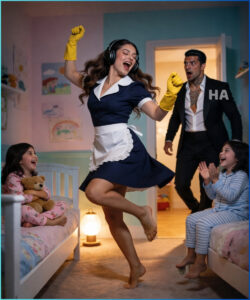
From inside the nursery came quiet now. A soft murmur. The rustle of sheets. One last sleepy giggle.
Reed closed his eyes.
His daughters had laughed.
And the woman responsible was not intimidated enough to be easy.
That should have made her dangerous.
For reasons he did not want to examine, it made her unforgettable.
By nine the next morning, Reed had cameras installed in the nursery, playroom, upstairs hall, downstairs sitting room, and west terrace.
If he was going to keep Elise Navarro in his house, then he was going to know exactly what she did there.
He stood in the front hall in a dark suit, coffee in one hand, while technicians threaded wires through plaster walls worth more than their annual salaries.
“Audio too,” he said.
The lead technician nodded. “Every room you listed.”
“On my office monitor, my tablet, and my phone.”
“Yes, sir.”
Frankie Torres, Reed’s longtime head of security, watched from near the staircase with the patience of a man who had survived Reed’s worst years and learned when silence was the smarter choice.
He waited until the technicians were gone before speaking.
“You think she’s a problem?”
Reed took a sip of coffee. “I think I don’t like not knowing.”
Frankie’s expression barely changed. “That’s not what I asked.”
Reed turned toward him slowly. Frankie was one of the very few men alive who could get away with that sentence.
“The girls are attached,” Reed said flatly. “I’m verifying what kind of person she is.”
Frankie nodded once, but his eyes were too sharp to let him off that easily.
“Sure,” he said. “That’s why you had cameras put in the playroom instead of the safe room.”
Reed walked away.
At noon, from the top floor office in Caruso Tower, he opened the live nursery feed.
He expected professionalism.
He expected routine.
He expected something tidy enough to be boring.
Instead he found the playroom transformed into a wilderness.
Elise had pulled couch cushions into a low fortress beneath two draped throws and a bedsheet clipped to lamp stands. Inside the makeshift cave, battery lanterns glowed. Maisie and Rosie crawled through the opening on their hands and knees, squealing.
“Elise,” Reed muttered to the screen.
On camera, she held one finger dramatically to her lips.
“Shh,” she whispered to the girls. “The lava monsters are listening.”
Rosie gasped on cue.
Maisie clutched a stuffed rabbit to her chest. “Are they big?”
“The biggest,” Elise said gravely. “But lucky for you, Captain Rosie and Captain Maisie happen to be the bravest cave explorers in Illinois.”
The girls crawled faster.
Inside the fort, Elise produced sandwiches cut into stars, apple slices arranged like flower petals, and juice boxes with bendy straws. The twins attacked lunch with an appetite Reed had not seen in months.
He looked down at his own untouched plate from the private kitchen: salmon, asparagus, a reduction sauce no one in his family history would have pronounced correctly.
On the screen, Elise pretended an apple slice was a shark fin. Rosie nearly fell over laughing.
Reed sat back in his leather chair and felt that same ugly sensation again.
Not jealousy exactly.
Displacement.
The warmth on that screen belonged to his house, his daughters, his dead wife’s memory, and somehow he was outside it, watching through glass like a man studying another family’s life.
He snapped the tablet shut harder than necessary.
At 4:30 p.m., he left work early for the first time in almost three years and stopped on Michigan Avenue to buy the most expensive dolls in a polished toy store. The saleswoman nearly floated while wrapping them.
By five-fifteen he was home, boxes in hand, certainty restored.
Children liked presents. He understood presents. They were clean, immediate, measurable. You gave, they smiled. The equation was civilized.
He stepped into the living room to find Elise sitting on the rug, back against an armchair, reading from a paperback. Maisie was tucked against one side of her. Rosie lay with her head in Elise’s lap, thumb at her mouth, eyes half closed.
All three looked up when he entered.
The room tightened.
The twins sat up, alert.
Reed forced brightness into his voice.
“Look what Daddy brought.”
He set the boxes down, knelt, and opened them with brisk competence. Two beautiful dolls emerged, all polished hair and pink dresses and tiny accessories packed in velvet-lined drawers.
He pressed one demonstration button.
Music burst out. Lights blinked.
Rosie flinched hard enough to choke on a breath.
Maisie recoiled.
Then both girls scrambled toward Elise at once.
Rosie buried herself against her waist. Maisie wrapped both arms around her leg.
Reed froze, one hand still on the doll.
The toy kept singing in a shrill, cheerful voice that suddenly sounded obscene.
The humiliation hit him hot and immediate. He shut the doll off.
“What did you tell them?” he asked.
Elise looked at him over the tops of the girls’ heads. There was no defiance now. Only fatigue and a kind of pity he could not stand.
“I didn’t tell them anything.”
“Then why do they act like I’m—”
“Because you arrive like thunder,” she said quietly.
He stared.
She shifted Rosie higher on her hip and went on before fear could stop her.
“They don’t hate you, Mr. Caruso. They don’t even fear you the way you think. They fear abruptness. Volume. Expectation. You come in fast, carrying noise and gifts and all your hope at once, and to little bodies that still remember losing their mother, that feels enormous.”
His throat tightened.
The girls clung harder to her.
Elise lowered her voice.
“The only thing they really want is for you to sit on the floor beside them long enough to stop feeling like a stranger.”
He wanted to argue. He wanted to tell her he paid for every stone in this house and every doctor in this city and every security system guarding these walls.
Instead he looked at his daughters hiding from him in plain sight.
And for the first time, a thought he had avoided with the skill of a professional liar became impossible to dodge.
Maybe he had not been abandoned by their grief.
Maybe he had abandoned them to his own.
He rose without another word and left the room, not because he was angry this time, but because staying would have shown too much.
That night, long after the house settled, Reed walked past the downstairs sitting room and saw a sliver of light under the door.
He pushed it open quietly.
Elise was asleep on the old sofa with the baby monitor on the coffee table beside her. She had never made it to her staff room. One arm dangled over the edge, fingers inches from the floor, as if she had fallen asleep mid-thought.
Below her hand lay a cheap silver plastic frame.
Reed bent, picked it up, and turned it over.
The world stopped.
In the faded photograph, Elise stood on a small stage in a rehearsal tutu, young and radiant, holding roses.
Beside her, one arm around her shoulders, smiling with pride so bright it hurt to look at, stood Kate.
Part 2
For a long second, Reed could not breathe.
Kate.
Not in an oil portrait. Not in a funeral program. Not in one of the guarded photographs he kept turned face down in his desk drawer like an old injury he sometimes pressed just to prove it still hurt.
Kate alive. Laughing. A hand on Elise’s shoulder. Light in her eyes.
His own grip tightened on the frame until the cheap plastic creaked.
Behind the photo backing, something had been tucked inside. Reed pulled it free with unsteady fingers.
A folded note. Yellowed at the edges.
He unfolded it and knew Kate’s handwriting before he consciously read the first word. The elegant slant. The loops on the capitals. The soft pressure on the downstrokes.
She had written him grocery lists with that handwriting. Notes on the mirror. One impossible farewell in a hospital bag he had been too shattered to open until months later.
For my little butterfly,
Never let anyone cut your wings. You were born to dance farther than this city can imagine.
Love,
Kate
Reed shut his eyes.
A conversation detonated in memory.
Two weeks before Kate died, she had sat at the edge of his bed in a silk robe, removing earrings after a foundation event and talking about one of her scholarship students with unusual urgency.
“She’s extraordinary, Reed. Not good. Extraordinary. When she dances, rooms go quiet. I’m getting her to New York if it kills me.”
He had been on a late call with a union boss and only half listening.
He remembered saying, “That’s great, sweetheart.”
He remembered not asking the girl’s name.
Now the name was sleeping fifteen feet away on his sofa in a navy uniform after a day spent caring for his children.
Elise Navarro.
The scholarship student.
The girl Kate had called her butterfly.
Reed lowered himself slowly into the chair opposite the sofa because his knees no longer seemed interested in helping.
He opened Elise’s employee file on the laptop left by the monitor and scanned what he should have read weeks earlier with his full attention.
Father deceased.
Mother ill.
South Side address.
Former dance training interrupted.
Employment history: caregiving, housekeeping, pediatric assistant shifts.
Interrupted.
What a polite word for ruined.
Because the minute Kate died, Reed had shut down the foundation.
He had done it in one meeting, with one signature, while numb with grief and furious at anything that carried his wife’s fingerprints. Grants canceled. Community programs dissolved.
Scholarship disbursements frozen. Staff released. He had called it simplification.
In truth, it had been destruction wearing a tie.
He stared at Elise’s file and understood, with clean horrifying clarity, that he had not only neglected his wife’s promise. He had shattered a young woman’s future without ever bothering to learn her face.
And that same young woman had walked into his house and spent the last two weeks patching his daughters together with dance, patience, forts, peanut butter sandwiches, and unearned loyalty.
He looked toward the sofa again.
Elise slept curled tight, even in rest as if protecting something already taken.
Reed set the frame back exactly where it had been, placed the note inside it again with careful trembling fingers, and walked out of the room carrying a weight so heavy it made the mansion feel small.
He did not sleep.
By dawn, shame had settled into him like iron.
He found Elise in the kitchen warming milk for the twins. Morning light touched the marble counters, the copper pans, the dark circles under her eyes. She was pressed, neat, composed again, as if she had not spent weeks absorbing everyone else’s chaos.
When she turned and saw him, her shoulders tightened almost imperceptibly.
“Good morning, Mr. Caruso.”
He hated the title suddenly.
“Morning.”
She set two small cups on a tray. “The girls are waking up. I can have breakfast ready in ten minutes.”
There was a pause, then she added, “I also packed my suitcase.”
Reed looked up sharply.
“If this is because of your mother yesterday,” she said, eyes lowered now, “I understand.”
His mother.
He had almost forgotten the visit in the shock of the photograph, but now it returned in full ugly sequence.
Diana Caruso had arrived the previous afternoon under a hard rain in cream wool, pearls, and flawless contempt.
She had looked Elise over like a stain on the silverware and spoken to her with the polished cruelty of a woman who considered humanity a rank-ordered list.
Elise had defended Rosie when Diana frightened her.
Reed had told Elise to take the girls upstairs.
Not because Elise was wrong. Because he had still been his mother’s son in the worst possible way.
He saw again the look Elise gave him then. Not fear. Not even offense. A disappointment so deep it had felt personal.
“No one is leaving,” he said.
Her head lifted.
“My mother doesn’t decide who stays in this house.”
Something in his tone made her go still.
He took one step closer, then stopped. He had no right to crowd her. No right to ask for anything. But the truth in him pressed against his ribs.
“What you did with the girls,” he said quietly, “it worked.”
Elise blinked. “I know.”
That should have annoyed him. Instead the corner of his mouth almost moved.
“She was wrong yesterday.”
Elise looked at him carefully, as if weighing whether those words were a confession or merely damage control.
“She usually is,” she said, then visibly winced at herself. “Sorry.”
He almost smiled again.
“You don’t have to apologize for accuracy.”
Her lips parted, startled into a tiny laugh she seemed to regret the instant it escaped.
The sound landed softly in the kitchen between them.
Reed swallowed.
“There’s something else,” he said.
Her expression changed, alert now.
He nearly told her then. About the photograph. About Kate. About the scholarship. About the man he had been and the damage he had caused while drowning in his own grief.
But fear caught him first.
Not fear of anger. He would have taken anger.
Fear that she would walk out before he had even begun to repair what he broke.
So he chose the coward’s halfway truth.
“I want you to keep doing whatever helps them,” he said. “Dance. Read. Build forts out of furniture. I don’t care if the living room looks like a toy store exploded. If it helps the girls, I want it.”
Elise stared at him.
“That’s… not what I expected you to say.”
“I’m trying something new.”
“What’s that?”
He met her eyes.
“Listening.”
For a moment neither moved.
Then the baby monitor crackled with one sleepy voice saying, “Ley?”
Elise was gone in an instant, tray in hand, leaving Reed alone with the smell of warm milk and the realization that trying to become a different man felt embarrassingly similar to learning how to walk.
The change was not immediate. Men like Reed did not thaw like movie snow.
They cracked in dangerous places first.
He started coming home before sunset.
The first day the staff nearly panicked. The second day Frankie called to ask whether a federal raid was imminent. By the fourth day people in three different branches of Caruso Holdings had invented health rumors to explain the boss’s new habit of leaving by five.
Reed ignored all of them.
At home, he sat on the floor.
The first time he did it, Maisie watched him with naked suspicion, as if a tiger had decided to fold itself into a nursery chair and announce it was one of the rabbits.
Rosie climbed into Elise’s lap anyway and studied him from there.
Elise sat across from him on the rug with a basket of wooden blocks.
“Don’t stare at them like that,” she murmured.
He frowned. “Like what?”
“Like you’re negotiating a hostage exchange.”
He looked at the girls. They were indeed watching him as if terms were still being discussed.
“What am I supposed to do?”
Elise pushed the basket toward him. “Build something terrible.”
“I’m sorry?”
“A tower,” she said. “A bad one. Kids love when grown-ups fail in entertaining ways.”
Reed, who had negotiated territorial ceasefires, bribed judges, acquired three office towers, and once talked a gunman into lowering his weapon in a back alley on Halsted, picked up a wooden block as though it might explode.
“This is absurd.”
“Completely,” Elise agreed. “Start there.”
He built the ugliest tower anyone in Chicago had ever seen.
Rosie stared.
Maisie leaned away from Elise by exactly three inches.
Reed added another crooked block. The whole structure collapsed.
He looked up.
Rosie laughed.
It was small, breathy, almost surprised out of her, but it was there.
Something inside him lurched.
He built another.
By the seventh collapse, both girls were edging closer. By the tenth, Maisie shoved a block into his hand with solemn authority, as though assigning him labor.
By the end of twenty minutes, Rosie was sitting beside his knee and correcting his architecture with the imperiousness of a tiny queen.
Elise said nothing. She simply watched, warm and quiet, as if she had known all along that the fortress between Reed and his daughters was made of less than it looked.
That evening, once the girls were asleep, Reed found her in the living room folding tiny socks.
“I saw the way you stopped yourself this afternoon,” she said without looking up.
“Stopped what?”
“Buying them with perfection.”
He leaned a shoulder against the doorway. “That obvious?”
“To me, yes.”
He watched her smooth one miniature sock against her thigh. Her hands were rougher than the rest of her, the hands of someone who had worked too hard for too long.
“I don’t know how to do this,” he said before he could stop himself.
Now she looked up.
“Do what?”
“Be what they need.”
The room softened around the admission.
Elise set the socks aside. “You don’t have to be magical. You just have to be present.”
He gave a humorless huff. “People keep saying versions of that like presence is simple.”
“It is simple,” she said. “Simple isn’t the same as easy.”
The answer went through him like clean cold water.
Three days later, he came home to music.
Not nursery music. Not cartoon jingles. Tchaikovsky, rich and bright, pouring through the formal living room as if someone had cut a skylight into the house.
The designer furniture had been pushed back. Afternoon sun spilled across the hardwood floor.
And Elise was dancing.
This time there were no yellow gloves. No comic faces. No headphones.
This was ballet.
Real ballet.
She moved in a plain white T-shirt and gray practice pants, barefoot, one turn flowing into the next with a precision so pure it made Reed’s chest hurt. Her arms seemed to finish thoughts his mind could not begin.
The room itself looked different around her, less like a mausoleum and more like a place built for breath.
Maisie and Rosie tried to imitate her in the middle of the floor, feet slipping, arms crooked, collapsing into giggles every few seconds.
Reed stood in the doorway, transfixed.
This, then, was the life that had been cut away from her.
Not some vague talent.
Not a pleasant hobby.
A calling.
Elise noticed him and stopped. “Sorry. I was just showing them—”
“No,” he said immediately. “Don’t stop.”
She did anyway. Old habit, perhaps. Or caution.
The girls looked at him, waiting.
He took off his suit jacket, loosened his tie, and heard himself say, “Teach me.”
Elise blinked. “Teach you what?”
“How to join them without wrecking it.”
A smile, slow and unexpected, touched her mouth.
“All right, Mr. Caruso.”
“Reed.”
She hesitated.
He held her gaze. “If you’re going to teach me to dance in my own living room, Reed feels more appropriate.”
Something warm flickered across her face. “All right, Reed.”
The sound of his name in her voice did strange things to the oxygen in the room.
She stepped closer.
“First, stop standing like a bodyguard.”
“I don’t stand like a bodyguard.”
“You absolutely do.”
Maisie nodded in solemn agreement.
Rosie copied her sister.
Traitors, Reed thought.
Elise lifted his arms gently by the wrists. “You’re too rigid. Children don’t trust rigid.”
“They seem to trust you.”
“I look ridiculous on purpose.”
“That doesn’t seem like the whole explanation.”
For one second their eyes met and held.
Then Elise stepped back and clapped once. “Big tree.”
He stared. “Excuse me?”
“You’re a tree. They’re squirrels. Sway.”
“This is extortion.”
“Sway, Reed.”
He did.
Awkwardly at first, a six-foot-three former prince of Chicago underworld logistics attempting to embody deciduous whimsy.
Rosie laughed so hard she fell against the sofa.
Maisie shouted, “Daddy tree!”
That did something to him, hearing the two words together in joy instead of panic.
He swayed more.
Elise circled him, laughing under her breath now, and the girls ran between his legs. Rosie stumbled. He caught her automatically. Maisie demanded equal treatment with the authority of royalty.
Soon he had one child on each arm.
“Spin,” Elise said.
“Absolutely not.”
“Spin.”
He spun.
The girls screamed in delight.
He lost his balance two turns later and crashed backward onto the rug with both daughters curled safely against him. There was a stunned beat of silence.
Then all three of them burst into laughter.
Real laughter. Messy laughter. The kind that scraped rust off a man’s soul.
Reed laughed until his ribs hurt. The girls climbed over him like he was a playground structure. Elise dropped to her knees beside them, eyes bright.
“There,” she said softly. “You’re in.”
He looked up at her from the rug, hair ruined, shirt untucked, daughters all over him, and knew with terrifying certainty that he had not felt this alive since before Kate died.
Then his phone buzzed.
Frankie.
Northern warehouse movement. Jung making a push. Need orders.
The old Reed would have sat up at once. Business first. Blood answered with blood. Territory before tenderness.
Instead he looked at the girls, at Elise, at the room transformed by music and late sun.
He turned the phone facedown on the floor.
“Not tonight,” he said.
Elise’s brows lifted. “Important?”
He met her eyes. “Not compared to this.”
She did not answer, but something in her expression deepened. Not romance. Not yet.
Recognition.
That night the storm rolled in hard.
By midnight the sky over Chicago had become a black cathedral of thunder. Wind slapped branches against the mansion windows. Rain came down in furious silver sheets.
At 2:11 a.m., Reed woke into darkness.
The power was out.
No hallway lights. No climate system hum. No discreet glow from security panels. The mansion, stripped of electricity, felt suddenly like what it really was underneath wealth: a giant old house with too many corners.
Then he heard crying.
Not terror this time.
Pain.
He was out of bed and into the hall in seconds, phone light cutting through dark.
Elise was already in the nursery when he arrived, candle lit, face pale.
“They’re burning up,” she said. “High fever. Fast.”
Reed touched Maisie’s forehead and nearly recoiled.
She was scorching.
Rosie was no better, skin flushed deep pink, breathing shallow and ragged.
“Call Emerson,” he snapped. “Now.”
“No signal.” Elise held up her useless phone. “Landline’s dead too.”
His own screen showed nothing. Not even one bar.
The storm had ripped the world away.
“I’ll drive,” he said. “Get them dressed.”
Elise caught his wrist. “The main road is flooded. A tree came down across the gate. We are not getting through in this.”
For a moment Reed simply stared at her, unable to process the words.
Cut off.
His daughters burning in his arms.
His doctors unreachable.
His money locked outside the weather like some expensive idiot.
The room tilted.
“They’re going to die,” he heard himself say.
The words came out raw, small, humiliatingly helpless.
Elise grabbed his face with both hands.
“Reed.”
He blinked.
“Look at me.”
He did.
“They are sick. They are not gone. Move.”
Her voice cracked through panic like a command.
“I need clean towels. Warm water in the tub. Apple cider vinegar. And I need you to stop being terrified long enough to help me save them.”
Part 3
He moved.
Not well. Not gracefully. But fast.
He filled the enormous bathroom tub with warm water while thunder rattled the windows. He ransacked cabinets for towels.
He limped into the kitchen in the dark, slammed his shin into a dining chair hard enough to swear aloud, found the vinegar, and came back half running.
By then Elise had stripped the girls down to their diapers and undershirts, her own sleeves rolled up, hair falling loose around her face.
“Get in,” she said.
He stared at the tub. “What?”
“Get in with them. Your body temperature will help. And they need the person they love.”
The sentence punched through him.
He stepped into the water fully clothed in black pajama pants.
Elise placed Maisie into his arms first, then Rosie. The girls whimpered weakly, their hot little bodies trembling against his chest.
He had held guns steadier than this. Money steadier. Power steadier.
He had never held anything that made him feel so defenseless.
Elise soaked cloths in the vinegar water mixture and pressed them gently to foreheads, necks, underarms.
“Easy,” she murmured. “Easy, my brave girls.”
Maisie cried harder, small body shuddering.
“Elise,” Reed said, voice breaking, “it’s not working.”
“It’s working,” she said without stopping. “It’s just not instant.”
Rain hammered the glass.
From the bedroom came the crackle of the backup military radio Frankie had insisted stay charged for emergencies. It hissed to life with static.
“Boss,” Frankie’s voice broke through. “Storm boxed us in on our end. More bad news. Jung used the weather. Hit the north warehouse. We’ve got men responding now.”
Reed stared toward the sound.
Empire or daughters.
Past or present.
Everything false or the only thing true.
“Handle it,” he shouted back toward the doorway. “However you need to. I’m not leaving.”
There was a beat of static.
Then Frankie, understanding everything inside those four words, answered, “Understood.”
The radio went silent.
Elise said nothing, but he felt her look at him.
Then, because fear had filled the bathroom so thickly it needed another language to break, she began to sing.
Spanish.
Low, soft, old-fashioned, carrying a rhythm like rocking water.
The melody brushed against Reed’s memory with painful familiarity. Kate had hummed that same song once, standing in the nursery before it was finished, one hand resting over her pregnant belly.
“Where did you learn that?” he whispered.
Elise wrung out another cloth.
“My grandmother.”
Reed shut his eyes for one second.
Of course.
Kate had learned it from the family of her scholarship student. Elise’s family. This house, this night, this song, had been connected long before he understood the pattern.
The storm raged.
The girls shivered.
Elise sang.
Reed held on.
An hour passed. Maybe two. Time dissolved into cloth changes, murmured reassurances, warm water cooled and replaced, Elise’s voice threading through all of it like a lifeline thrown across black water.
Then Maisie’s skin shifted beneath his hand.
Damp. Cooler.
Rosie’s forehead followed.
Elise touched both girls, eyes suddenly flooding with exhausted relief.
“The fevers are breaking.”
Reed bowed over them, his forehead nearly touching Rosie’s curls, and a sob tore out of him so violently it left him shaking.
He did not hide it.
There was no point anymore.
Thank God.
Thank God.
Thank God.
Elise sank to the tile floor beside the tub, soaked through, spent, hair plastered to her cheeks. She looked like ruin and victory at once.
“You stayed,” she whispered.
He looked at her across the edge of the tub.
“You led.”
“No,” he said. “You saved us.”
The words were too small for what he meant, but they were all his throat could manage without breaking again.
Later, when the girls were dry and back in clean pajamas, sleeping at last in their cribs with sweat-damp curls and peaceful faces, Reed and Elise ended up on the nursery floor beneath the fading candlelight.
He sat with his back against the chair. She sat beside him, legs stretched out, shoulder almost touching his.
For a while they listened to the storm move farther away.
Then Reed said, “I saw Kate die.”
Elise turned her head.
The confession came out of him slowly, as if grief were a locked drawer rusted shut.
“I’ve spent three years trying to outrun that moment. Every cry, every fever, every slammed door, it all drags me back there. Tonight I was in that hospital again before we were even halfway to the tub.”
Elise was very quiet.
“I thought if I controlled everything, I could keep loss from happening again,” he said. “Schedules. guards. cameras. noise. silence. gifts. distance. I built a fortress so grief couldn’t get in.”
He laughed once, bitterly.
“All it did was trap my daughters inside with me.”
The nursery lamp cast gold across Elise’s face.
“You’re not the only person who’s loved badly because they were scared,” she said.
He looked at her.
She hesitated, then continued.
“My father died when I was ten. My mother started taking every shift she could get, and I became whatever the house needed. Daughter, sister, babysitter, cleaner, cook. I got very good at surviving. Very bad at asking for anything.”
Her mouth curved faintly, not with humor but recognition.
“Kate was the first person who looked at me and saw more than usefulness.”
Reed’s whole body stilled.
He could not keep the truth any longer.
“Elise.”
She glanced at him.
“I know.”
The words were soft, but they landed like a blade.
She frowned slightly. “Know what?”
He turned toward her fully.
“The photograph. On the sofa. I saw it.”
Her face drained of color.
“I know you were Kate’s scholarship student. I know she called you her little butterfly.”
Elise stared at him without breathing.
“And I know,” he said, voice rough now, “that when she died, I shut down the foundation and killed your scholarship with one signature because I was too broken and selfish to care what else I was destroying.”
Silence.
Not empty silence. Impact silence. The kind that follows shattered glass.
Elise’s eyes filled slowly.
“I didn’t tell you because I was afraid you’d leave,” he admitted. “Which was cowardly. And cruel. And unfair.”
Her lips trembled once. “I came here because of her.”
“I know.”
“I didn’t want your money.”
“I know.”
“I came for the girls.”
“I know that too.”
One tear slid down her cheek. She didn’t wipe it away.
“She loved them,” Elise whispered.
“I know.”
He almost said it again just to stay inside that bridge between them, but the truth had one more poison left.
“There’s something else.”
She went still.
Reed felt the words turn to lead in his mouth.
“The order that killed your father,” he said, each sentence scraping him raw, “came through my family’s organization. I was twenty. I didn’t give the order. But I carried the name. And for a long time I carried the life that made those kinds of deaths possible.”
Elise looked at him like he had become someone else before her eyes.
Pain crossed her face first. Then shock. Then old grief dragged up by fresh hands.
He did not reach for her.
He did not defend himself.
He just sat there and let the truth stand between them like a grave marker.
At last she whispered, “Why would you tell me now?”
“Because after tonight,” he said, “I would rather lose you honestly than keep you with another lie.”
The candles hissed softly.
Outside, rain thinned to a whisper.
Elise lowered her eyes. When she spoke again, her voice had changed.
“I should hate you.”
“Yes.”
“I should take my suitcase and disappear before sunrise.”
“Yes.”
She let out a shaky breath.
“But Maisie and Rosie will wake up calling for me.”
“Yes.”
“And if I leave because of the sins of powerful men, then your daughters pay for something they never did.”
Reed could barely draw air.
Slowly, Elise leaned her head back against the chair and closed her eyes.
“Kate used to tell me forgiveness was not approval,” she murmured. “It was refusing to let evil decide the shape of the rest of your life.”
He stared at her.
Then, without warning, she laughed once through tears. Soft. Tired. Almost incredulous.
“What?”
She opened her eyes and looked at him sideways.
“I’m thinking that a Chicago crime king knelt in a bathtub and took orders from a nanny with apple cider vinegar.”
A broken laugh escaped him before he could stop it.
“Yes.”
“That’s a ridiculous image.”
“You said ridiculous can save a night.”
Her smile deepened, fragile and real.
He lifted one hand slowly, giving her room to refuse, and touched her cheek.
Elise did not pull away.
Instead she turned into the contact with quiet, devastating trust.
“Don’t go,” he said.
It was not a command.
It was not a bargain.
It was a plea stripped bare.
“I won’t leave the girls,” she said.
The answer should have hurt, being so specifically about them.
Instead it felt like mercy.
Exhaustion took them both after that. Not romance. Not fireworks. Just two human beings emptied by fear and truth and relief, sitting shoulder to shoulder on the nursery floor until sleep quietly overcame them.
Morning arrived bright and deceptive, the storm scrubbed out of the sky.
Reed woke first, stiff-necked and cold and strangely happy.
The girls were still sleeping peacefully.
Elise was curled on the rug, one loose strand of hair across her cheek.
He stood, heart light enough to feel almost young, and knew exactly what he was going to do.
He would shower.
He would make coffee.
He would tell her everything again, properly this time, with no evasions.
Then he would tell his mother that her influence ended here.
And after that he would begin fixing the damage he had spent three years denying.
He left the nursery quietly.
By the time he came out of the shower, buttoning a white shirt with damp hair and a kind of foolish hope he had not allowed himself in years, the house had already been poisoned again.
Diana Caruso had arrived unannounced.
She found the nursery first.
She found Elise sleeping on the floor near Reed’s discarded pajama jacket and concluded exactly what her own ugliness wanted her to conclude.
By the time Reed reached the door, the room was chaos.
The twins were shrieking.
Toys littered the floor.
Diana sat in the nursing chair with an architecture magazine as if she were waiting in a lounge instead of at the center of a storm.
Maisie and Rosie threw themselves toward him the moment they saw him.
“Daddy! Ley! Ley!”
Reed dropped to his knees and gathered them both. Their little bodies shook with betrayal.
He looked up at his mother.
“Where is Elise?”
Diana turned one page with icy calm. “Gone.”
His entire body went still.
“Gone where?”
“I removed her.”
The words were so mild they were monstrous.
“What did you do?”
“She was found on the floor in your daughters’ room, half dressed, your clothing everywhere, clearly taking advantage of the storm to crawl where she did not belong.” Diana set down the magazine. “I had her thrown out before she could infect this house any further.”
For a moment Reed heard nothing.
Then the sound returned all at once: his daughters sobbing, blood in his ears, something inside his chest opening like a snapped chain.
“She was with them all night,” he said. “Saving your granddaughters.”
Diana rose with the stiff majesty of a woman who had mistaken fear for respect all her life.
“She is a servant.”
“No,” Reed said.
The word came out low enough to frighten even him.
“She is the only reason this house is still standing.”
Diana’s eyes flashed. “Don’t be hysterical. I cleaned up a problem.”
Reed stood, still holding both girls.
“No,” he said again, louder this time. “You created one.”
She lifted her chin. “Watch your tone.”
And then, after thirty-seven years of obedience dressed as damage control, Reed Caruso finally broke.
“Get out of my house.”
The roar shook the glass.
The twins fell silent in shock against his shoulders.
Diana paled. “Excuse me?”
“Get out,” he repeated. “Get out of this house. Get out of my daughters’ lives. Get out of mine.”
Her hand tightened on her cane. “If you speak to me this way, you will regret it. I can remove you from the council. I can strip you of every protection you have.”
He laughed, and there was nothing polite left in it.
“Keep the council. Keep the inheritance. Keep the damned pearls and power games and all the rot that comes with them.”
He kissed Maisie’s head, then Rosie’s.
“None of it is worth one smile from my daughters.”
Then he handed the girls to the nearest trusted housekeeper, gave one order to lock his mother out once she crossed the threshold, and ran.
He nearly took his black sports car.
Frankie’s voice cracked over the radio just in time.
“Boss, don’t start the coupe. Jung’s people got under it during the storm. Device confirmed.”
Reed stared at the car for half a second, then lunged for the armored SUV instead.
He tore out of the garage and onto the wet street with his shirt misbuttoned and his whole future hanging on whether a woman with reason to hate him had decided to wait for a bus.
She had.
At a rusted stop near the interstate, Elise sat alone with one old suitcase at her feet and scraped hands folded too tightly in her lap.
When the SUV screeched to a stop in front of her, she stood instantly, frightened.
Reed jumped out and ran toward her.
“Elise!”
She backed up until the dirty plexiglass shelter caught her shoulders.
“Mr. Caruso, please,” she said quickly. “I didn’t take anything. Your mother can check my suitcase. I swear there’s nothing in it.”
That sentence almost destroyed him.
This woman, who had spent the night saving his daughters, thought he had come to accuse her of theft.
He stopped several feet away, breathing hard.
“No. No, don’t say that. I know.”
Her eyes shone, guarded and wounded.
“My mother lied,” he said. “She threw you out while I was upstairs. I didn’t know. I swear to God, Elise, I didn’t know.”
She said nothing.
Traffic hissed by on wet pavement.
“I know who you are,” he said softly. “I know what Kate meant to you. I know what I took from you.”
Her face changed as he spoke, every defense straining against emotion.
“And I also know,” he forced himself to continue, “that my family’s world took your father from you. I know I’m asking forgiveness from the wrong side of history.”
He went to his knees right there on the wet concrete.
Cars passed.
A truck horn blared in the distance.
The city kept moving.
Reed Caruso, feared in boardrooms and back alleys alike, knelt before a woman in a bus shelter with nothing to offer her now except truth.
“You owe me nothing,” he said. “Not kindness. Not trust. Not another hour in my house. But my daughters are innocent. And I…” He had to stop and steady his breath. “I am in love with the life you brought back into them. Into me. If you walk away, I will understand. But I had to come tell you that before the bus did.”
Elise stared at him through tears that had returned against her will.
For a long time neither moved.
Then she looked down the road where the bus was slowly approaching, all escape and distance and self-protection in one square machine.
When she looked back at Reed, something gentler than triumph and stronger than pity had entered her face.
“The hardwood floor in your living room really is excellent for turning,” she said.
Reed’s laugh came out half broken, half disbelieving.
He stood carefully, as if any sudden move might shatter the moment, and this time when he reached for her, Elise let him.
He wrapped her in his arms.
She trembled once, then held on.
A year later, the mansion on Aster Street no longer looked like a house curated for the dead.
There were tricycles in the foyer.
Crayon drawings on the pantry door.
Tiny ballet slippers by the back entrance.
Peanut butter in a kitchen once designed for catered restraint.
Music at odd hours.
Laughter at improper volumes.
The designer living room had become a permanent dance space.
On a winter evening filled with candlelight and the smell of cinnamon, Reed sat on the floor in jeans and a black T-shirt while Rosie, now five, leaned sleepily against his shoulder. Maisie chased soap bubbles with the determination of a future attorney.
In the center of the room, Elise danced in a soft lavender dress.
Not because she had to prove anything anymore.
Not because she was trying to survive.
Because joy had finally become reason enough.
When the music ended, she bowed to a roaring audience of two children and one man who had learned that worship could be tender instead of violent.
Reed crossed the floor and wrapped his arms around her waist.
“Bravo, Mrs. Caruso.”
She smiled up at him. “Your reviews are biased.”
“They are passionately objective.”
She laughed.
Over the past year, much had changed beyond those walls too.
Victor Jung, the rival whose men had moved against Reed during the storm and whose network had long been tied to the hit that killed Kate, was now in federal custody thanks to evidence quietly delivered through channels even the underworld respected. Frankie had supervised the transition of Caruso operations away from the old machinery of blood and into legitimate holdings with the patient ruthlessness of a man cutting rot out of timber.
Reed had reopened Kate’s shuttered charity under a new name: The Butterfly Foundation.
Its first scholarship was awarded to a twelve-year-old girl from Brighton Park with impossible feet and a fierceness in her turns that made Elise cry in the audience.
Elise’s mother had begun proper treatment and was strong enough now to come for Sunday dinners, where the twins called her Abuela and fed her too many cookies.
As for Diana Caruso, she remained very rich, very furious, and very unwelcome.
Sometimes consequences arrive as gunfire.
Sometimes they arrive as locked doors.
Reed preferred the second kind now.
“Daddy,” Maisie called, climbing onto a chair. “Dance!”
Rosie lifted both hands from the rug. “Both of you!”
Reed offered Elise his hand with ceremonial solemnity.
“May I have this dance?”
She placed her palm in his.
“Always,” she said. “Even when you’re half a beat late.”
He drew her close. The girls spun around them. The music started again, an upbeat jazz version of the old Spanish lullaby that had once carried them through fever and fear.
They were not perfect dancers.
They stepped on each other.
They laughed in the wrong places.
They turned too fast when the girls joined in.
But the house was warm.
The children were safe.
The past no longer owned the future.
And in the middle of Chicago, inside a mansion once ruled by silence, a man who had built his life on power finally learned the thing that saved it.
Love was never the weapon.
It was the surrender.
THE END