The town wanted to punish the cowboy with the cursed Apache widow…but he accepted without fear and broke the curse of the Wild West!
In Red Hollow, punishments were usually simple: bullet, rope, or exile. But that day, the whole town gathered to witness something that reeked of scandal and superstition.
Clint Dawson, a cowboy weathered by wind and solitude, with steely blue eyes and sun-weathered skin, stood before the sheriff, his wrists bound and his hat perched on his head with insolent dignity.
His crime wasn’t murder or theft. It was compassion. He had helped three Apache women escape the militia wagon train. To most of Red Hollow, the Apaches were little more than a plague. To Clint, they were people.
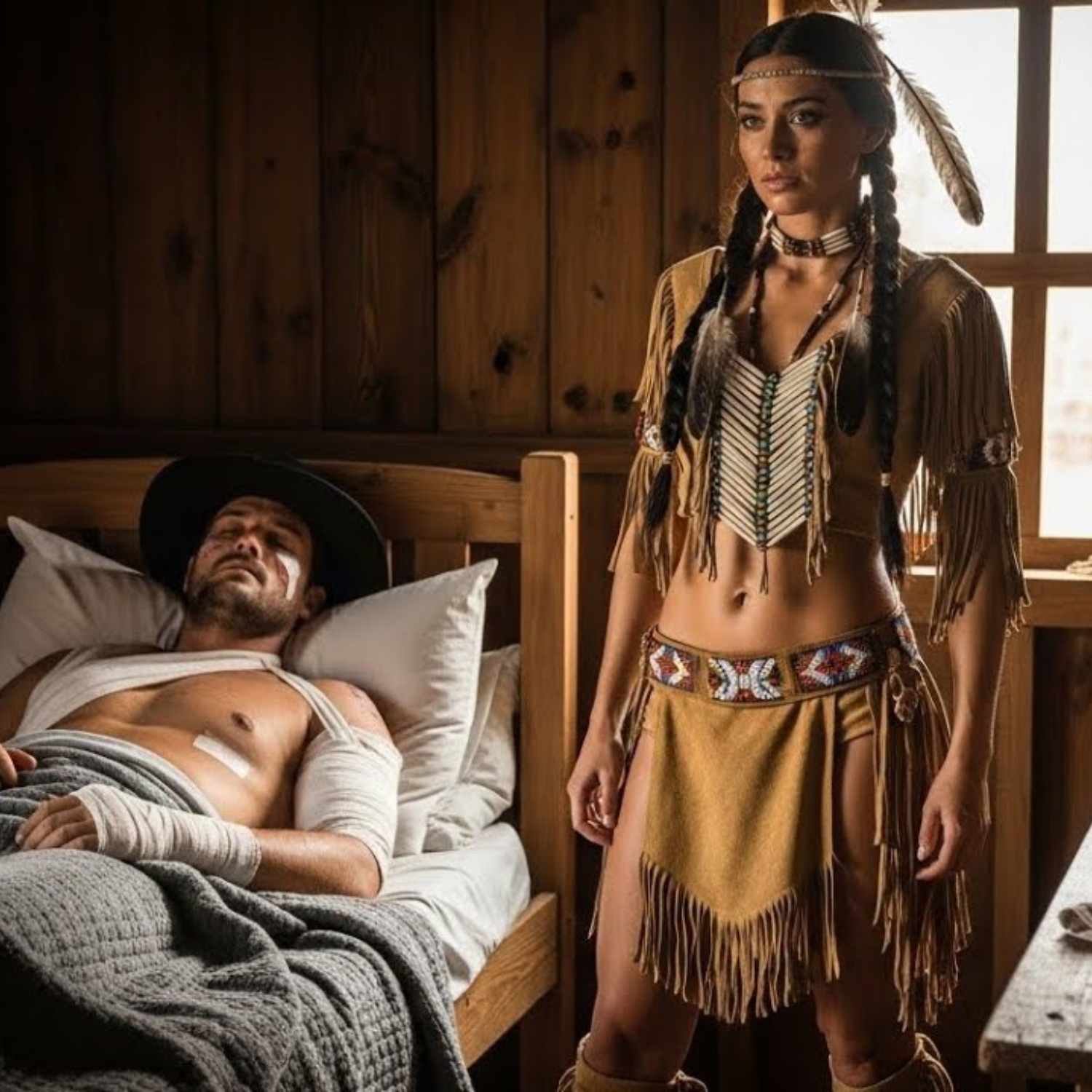
The sheriff read the sentence slowly, letting each word slither through the crowd like a venomous snake.
“Instead of hanging, Clint Dawson will pay by marrying the Apache widow. The damned woman.”
A murmur of horror and morbid curiosity filled the air. Even Clint raised an eyebrow. Everyone knew the stories. Ayana, the widow of an Apache leader, was the bearer of a curse.
Two men had tried to claim her after her husband’s death. Both had turned up at the bottom of Devil’s Canyon, torn to pieces as if devoured by wolves or spirits. No one dared utter her name without spitting.
Children hid when she passed by. The judge concluded:
“You marry her, rancher. You live with her. If death claims you, so be it. Apache curse or justice, the town will sleep soundly.”
Everyone expected Clint to break down, to beg for his life, to cling to his last breath like any man before an invisible noose. But he looked at them all, and in a voice as firm and calm as flowing water, he said:
“If it means she’ll never suffer alone again, then I’ll marry her.”
Silence. Then nervous laughter and incredulous stares. Some thought Clint was already cursed for accepting such a fate. Ayana wasn’t even there. She lived on the edge of the canyon, where the wind wept and no one dared approach.
Clint imagined her reaction: fear, anger, sadness. As they untied his wrists, he didn’t run or hesitate. He adjusted his hat, nodded, and walked toward his destiny, leaving the town speechless.
The ride to the canyon was longer than any route Clint had ever ridden. The air grew thicker, the silence deeper, as if even sound feared approaching the cursed widow.
Ayana’s house, a clay shack like dried bone, half-ruined by storms and neglect, seemed a corner forgotten by the world. There were no animals, no campfire smoke. It was exile laid bare.
Clint dismounted, tied up his horse, and rode forward without hesitation, though the wind whistled warnings. The gate creaked before he reached it.
Ayana appeared, tall and poised, her black hair braided and adorned with feathers worn smooth by time. Her dark, sharp, and unreadable eyes scanned Clint’s face and the document that declared them husband and wife.
She didn’t lower her head or blink: she was a warrior who had already lost everything and feared nothing.
Clint tipped his hat in respect.
“I suppose you’ve heard the town’s decision. Looks like we’re married.”
I expected anger, mockery, or contempt, but Ayana only tilted her chin.
“You didn’t choose this,” he whispered, his voice thick with smoke and ash.
“Maybe not. But I wasn’t forced into it either,” Clint replied, shrugging.
Ayana frowned slightly. The men always arrived with violence or fear, never with neutrality. Never with a calm voice. She let him in. The interior was austere: blankets on the floor, dried herbs hanging, an old bow in the corner.
It smelled of sage and earth. Clint put down his backpack and asked about the well. Ayana pointed down the rocky path, warning of coyotes that had no fear of men. Clint nodded, indifferent to the danger.
When he left, Ayana watched him from the doorway, expecting to see regret or terror. But he walked straight ahead, shoulders back, like someone moving toward life, not away.
For the first time in years, Ayana felt something strange: a twinge of hope.
The days passed, measured not by clocks, but by chores, silences, and the slow rebuilding of two shattered lives. Clint repaired the roof, patched the holes, and rekindled the fire in the forgotten hearth.
He hunted rabbits and brought back meat without asking for anything in return.
He kept watch at night when drunks from the village approached out of curiosity or cruelty. He never demanded gratitude or comfort. He acted as a husband, even though neither of them uttered the word.