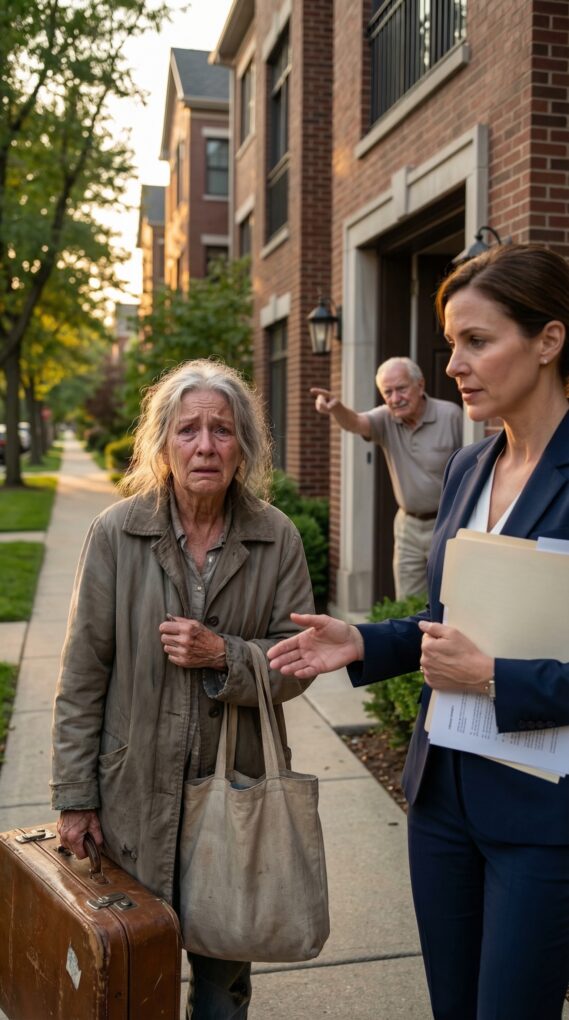
At seventy-three, I stood on a sidewalk in Phoenix with one rolling suitcase, a canvas tote full of pills and paperwork, and nowhere to go. Three hours earlier, the judge had finalized my divorce from Ronald Hayes,
the man I had spent the last twenty-two years with. By sunset, the locks on the condo had been changed. Ronald did not bother pretending to be sorry. He leaned against the doorway in his golf shirt, arms folded over his stomach,
and laughed like I had told him a harmless joke.
“Nobody needs you, Evelyn,” he said. “You’re too old to start over.”
I wish I could say I answered with dignity. The truth is, I just stared at him, too stunned to speak, while the maintenance man avoided my eyes and carried the last box to the curb. Inside that box were framed photos,
winter sweaters, my late mother’s recipe cards, and a marriage certificate that suddenly felt like a bad receipt I should have thrown away years ago.

I had married Ronald at fifty-one, after a lonely decade of raising my daughter, Megan, mostly on my own. My first marriage, back in the 1970s, had ended quietly and without drama. Daniel Mercer and I were too young, too broke, and too proud.
We divorced after four years. No children, no property, no reason to stay in touch. A few Christmas cards came in the early eighties, then nothing. I heard through an old friend that Daniel had moved to California and gone into commercial real estate.
Later, I heard he had done very well. Then I stopped hearing anything at all.
My life with Ronald looked respectable from the outside. Church on Sundays. Dinners with neighbors. Shared photos on anniversaries. But in private, he managed money like a weapon. The condo was in his name.
The car I drove was leased through his business. When I quit part-time bookkeeping after my hip surgery, he began calling me “dead weight” whenever he was angry. I told myself this was what aging looked like: smaller choices, quieter humiliations, fewer exits.
That afternoon, I sat on a bench outside a legal aid office because I had nowhere else to sit. I was trying not to cry when a woman in a navy suit stepped out and asked if I was Mrs. Evelyn Hayes.
I nodded.
She held out a card. “My name is Laura Bennett. I’ve been trying to find you for six months. Your first husband, Daniel Mercer, passed away. He left you forty-seven million dollars.”
My suitcase tipped over onto the pavement.
For a moment, I thought Laura Bennett had mistaken me for someone else, or worse, that this was some elegant kind of fraud designed to prey on old women with tired faces and nowhere to sleep.
I looked at her business card, then at the office behind her, then back at her calm, professional expression. Nothing about her suggested a scam.
She knew Daniel’s full name, the county where we had married in 1974, and even the address of the tiny apartment in Tucson where we had once eaten canned soup on upside-down moving boxes.
“I understand this is overwhelming,” she said gently. “But Mr. Mercer was very clear. He wanted you found.”
Inside her office, she showed me copies of the trust documents. Daniel had never remarried. Over the years, he had built a real estate empire across Arizona, Nevada, and California. Shopping centers, apartment developments, industrial parks.
The number at the bottom of the asset summary looked unreal, the kind of figure you see on business channels and ignore because it belongs to another species of human. My share, after taxes and charitable allocations he had specified,
would still change every remaining year of my life.
I kept asking the same question. “Why would he leave anything to me?”
Laura slid a sealed envelope across the desk. My name was written on it in a hand I recognized instantly, though older and less hurried than I remembered.
Inside was a letter.